Within the past couple of years, it has become common knowledge how stress and anxiety symptoms can wreak havoc on our bodies. If we compound a poor diet, lack of exercise and the worries of dealing with everyday stress and anxiety, we have weakened our bodies to allow fatigue, common colds, aches & pains, etc., to impede on our nervous system. Starting about 4 years ago, I began to have fatigue for no reason, shortness of breath and chest pain. These symptoms would appear out of nowhere and I had convinced myself that I was not stressed or possibly having anxiety attacks. I made multiple emergency room visits, convinced I was having a heart attack or had an underlying medical condition. Unwilling to hear that I was having panic attacks, I demanded in-depth tests and a complete cardiac work-up to evaluate why I was having these debilitating symptoms. Thankfully, each test I had revealed nothing abnormal, but I was left with no answers. I felt as though my only option was to find a diagnosis for my problem, but how can you diagnose a panic attack?
I was strongly opposed to the idea that these very real symptoms were the result of stress. How had I been through so many "stressful" situations in the past without having panic attacks? It only made sense to me that I would have had a panic attack then. But when my symptoms started, I felt as though my life had finally fallen into place. I was happier than ever with not a worry in the world. Albeit, my symptoms continued for 2 years before I relented to trying medication. My family physician prescribed Zoloft, which is a medication commonly used for depression and anxiety disorders. I titrated to the recommended dose for anxiety and waited for the calm to come. My panic attacks did lessen, but not without a few unwanted side effects. At this time in my life I also began to evaluate how I was taking care of myself or the lack thereof. I did some research on the internet and found a chiropractor that specialized in stress management. Not only did I incorporate chiropractic adjustments into my regimen, but my chiropractor introduced the importance of taking care of my whole being. Yes, the adjustments helped greatly with tense muscles and the ability to relax, but he informed me that I needed more. I was educated on the importance of diet and exercise and how that will positively affect my nervous system. My weight had always been under control but it wasn't due to the proper diet or exercise. I decided to start exercising for the cardiovascular benefits and to cut out unnecessary fast food. This change in diet and exercise didn't happen overnight, but I was on the right track.
After being on Zoloft for a little over a year, I decided it was time to wean myself off. I was feeling really good with very little panic attacks and I didn't see the need to continue the medication. I understand that the reason I was probably feeling so good was partially because of Zoloft, but I wanted to give it a shot without the medication. I decreased my dose slowly, week after week. Sometimes I could tell if I decreased too fast because I would have these dizzy spells and bouts of emotion that were unusual. Going off of this medication was a very tedious process that took about 3 months. I had never had depression issues before Zoloft, and I didn't after Zoloft, but it is very apparent once you are off of the medication how it had masked your emotions so successfully. I was easy to cry again at sentimental moments and a little faster to become aggravated. I was very worried what would happen once I was off of the medication. Nothing was worth my anxiety attacks coming back. I had made a lot changes in my life, besides the Zoloft, and I was willing to see my capability. My diet was successful in the fact that I consciously added more fruits and vegetables, and less fats with fast-food. Exercising became routine, and although I didn't spend hours in the gym, my cardiovascular work-out grew to 3 to 5 times per week. I continued to visit my chiropractor for routine adjustments to relieve the stress in my muscles. I didn't realize I had so much tension in my neck and midback that I feel caused a lot of my anxiety. He worked with me on stretches to loosen my muscles and keep my body physically healthy. I could tell my body was healthier just by the way I felt. Now off of the Zoloft, I still have a few panic attacks, but nothing like before. I blame the past on the fact that I wasn't leading a healthy lifestyle that was necessary to keep my body where it should be. I maintain my health now with regular chiropractic adjustments, diet and exercise. It really is that easy!
If you need help managing your stress and anxiety symptoms along with the help from your family physician, Living with Motion Chiropractic is here to HELP! Remember that you are not the only person with stress and we encourage you to look for healthy alternatives to diminish those symptoms of anxiety and improve your overall health. Contact Dr. Reineck at (513) 831-4433 or schedule an appointment online at www.livingwithmotion.com.
Related Post:
Why is dealing with stress important to my health?
Thursday, March 31, 2011

Tuesday, March 22, 2011
Why is dealing with stress important to my health?
As a chiropractor, I see how stress can impact a patient’s health just about everyday. Stress can impact degeneration in a patient’s spine, create anxiety, cause sleep disturbances, promote poor digestion and so on. I always hear people say, "Ohhh its just stress, I’ve learned how to live with it!" It may be true that we have learned how to live with it, but we are not dealing with stress in a way that is productive to our health. Let's look at ways we can properly adapt and process stress and not let stress, stress us out!
Identifying the stressor should be the first step we take to properly deal with stress. Stress does not always present itself with a big red bow on its head. For instance we may not think of going for a 5 mile run as a stressor to our body. Running is great cardiovascular exercise and I promote running, but it is a stressor to the body. Any exercise is going to breakdown muscle, lactic acid builds up and we get soreness. So what do we do? We stay hydrated so muscle's can function properly and get lactic acid out and nutrients and oxygen in. This is an example of how we effectively manage any kind of stress. We know the stressor and make sure we respond to that stressor in a way to diminish its potential negative side effects. Lets look at emotional stress. Someone at work is not pulling their weight causing production to slow down and increases your workload. I think this would anger and stress most people out in this situation. What do you do? Some get angry and hold a grudge against a fellow employee. Others stress about the situation and blame the job. The key is being capable of staying calm. Over reaction to any situation is going to further promote the stress response and be counter productive to your health. I think the first thing to be aware of is that feeling of tension building up. We can use simple relaxation techniques to prevent this tension building into a headache, neck pain, shoulder pain, etc. One example; in the sitting position, lean back, let your arms hang to your side, and rotate your thumbs out. This will let your shoulders open up, take tension off your shoulders and allow you to BREATHE. Practice this throughout the day and allow oxygen to get deep into your lungs. Breathe in through your nose and out through your mouth. Deep breathing exercises are an excellent way to divert stress and not allow it to affect you physically.
In the book The Success Principles, the equation E+R=O describes the relationship between an event (E), in this case a stressor, and how the outcome (O) of that event comes to be. The variable to this is R. R in this equation stands for response. It is our response or reaction to a stressor that predicts the outcome of that situation. If we work out hard and don't hydrate - we feel sore and achy. If we work out hard and hydrate before and after with appropriate stretching, we feel amazing! If we get into an argument with a spouse and blow up, over dramatizing the situation - we get a long drawn out fight. If we get into an argument with a spouse and stay calm, breathe, respect them - we get a resolution to the problem without hurting each others feelings! I think we see how this works.
The greatest thing about being a Chiropractor is that we try our best to see the big picture of a person. Granted many times patients initially come to us because of pain. Once that issue is resolved, we can talk about the whole person and options to get them feeling better than ever. Understanding the principles of how our body works and what we can do to enhance that, is so much fun! Chiropractors can help so many people in dealing with stress not only in the spine but emotionally and physically. To learn other useful health related tips and schedule an appointment to see how stress maybe impacting your health - visit www.livingwithmotion.com.
Related Post
Why Postural Stress Can Create Spinal Degeneration
Identifying the stressor should be the first step we take to properly deal with stress. Stress does not always present itself with a big red bow on its head. For instance we may not think of going for a 5 mile run as a stressor to our body. Running is great cardiovascular exercise and I promote running, but it is a stressor to the body. Any exercise is going to breakdown muscle, lactic acid builds up and we get soreness. So what do we do? We stay hydrated so muscle's can function properly and get lactic acid out and nutrients and oxygen in. This is an example of how we effectively manage any kind of stress. We know the stressor and make sure we respond to that stressor in a way to diminish its potential negative side effects. Lets look at emotional stress. Someone at work is not pulling their weight causing production to slow down and increases your workload. I think this would anger and stress most people out in this situation. What do you do? Some get angry and hold a grudge against a fellow employee. Others stress about the situation and blame the job. The key is being capable of staying calm. Over reaction to any situation is going to further promote the stress response and be counter productive to your health. I think the first thing to be aware of is that feeling of tension building up. We can use simple relaxation techniques to prevent this tension building into a headache, neck pain, shoulder pain, etc. One example; in the sitting position, lean back, let your arms hang to your side, and rotate your thumbs out. This will let your shoulders open up, take tension off your shoulders and allow you to BREATHE. Practice this throughout the day and allow oxygen to get deep into your lungs. Breathe in through your nose and out through your mouth. Deep breathing exercises are an excellent way to divert stress and not allow it to affect you physically.
In the book The Success Principles, the equation E+R=O describes the relationship between an event (E), in this case a stressor, and how the outcome (O) of that event comes to be. The variable to this is R. R in this equation stands for response. It is our response or reaction to a stressor that predicts the outcome of that situation. If we work out hard and don't hydrate - we feel sore and achy. If we work out hard and hydrate before and after with appropriate stretching, we feel amazing! If we get into an argument with a spouse and blow up, over dramatizing the situation - we get a long drawn out fight. If we get into an argument with a spouse and stay calm, breathe, respect them - we get a resolution to the problem without hurting each others feelings! I think we see how this works.
The greatest thing about being a Chiropractor is that we try our best to see the big picture of a person. Granted many times patients initially come to us because of pain. Once that issue is resolved, we can talk about the whole person and options to get them feeling better than ever. Understanding the principles of how our body works and what we can do to enhance that, is so much fun! Chiropractors can help so many people in dealing with stress not only in the spine but emotionally and physically. To learn other useful health related tips and schedule an appointment to see how stress maybe impacting your health - visit www.livingwithmotion.com.
Related Post
Why Postural Stress Can Create Spinal Degeneration
Friday, March 18, 2011
Natural Alternative to Being Smoke Free!
Just Stop! Smoking Cessation Program Is Now Available at Living with Motion Chiropractic!
Scientific evidence suggests smoking cigarettes is as addictive as using drugs such as cocaine and heroin. Despite its known adverse effects, the severe withdrawal symptoms have probably led you or your loved ones to continued use. Within just 7-10 seconds of inhaling cigarette smoke, nicotine releases the feel good chemicals of endorphins, serotonin and dopamine that provide feelings of pleasure and alertness – this is the “hit which addicts”. Within 30 minutes of your last cigarette, nicotine levels drop and withdrawal symptoms begin which make you tired, depressed and anxious – to name a few.
Smoking actually suppresses the natural production of endorphins and serotonin and after a while, the only time these chemicals will be produced is when you are smoking. Laser therapy naturally stimulates endorphin production so you won’t experience the intense withdrawal discomfort or cravings. In addition, laser treatments calm, relax and enhance the energy system in the body, providing a quick recovery from tobacco addiction.
BioVeda’s Just Stop! Smoking Cessation Program
Is a simple 7 day program using a combination of low level light therapy (LLLT), homeopathic support and herbal remedies to help you to quit once and for all, while reducing cravings, side effects, stress and irritability. You should not gain weight while your metabolism is returning to normal.
The program goes a step further by also helping to remove harmful toxins known to build in the blood, tissue and cells through habitual use of tobacco products, minimizing the longer-term side effects related to smoking. We are proud to offer this program - it is one of the best, most successful and easiest ways to “Just Stop!”.
How it Works:
· 3 visits over a one week period
· Use of the herbal remedy, “Just Stop!” for 1 week in conjunction with the laser visits
· Use of the homeopathic supplement, “Just Stop Too!”* during the week of smoking cessation and then 1 month for each year of smoking up to 5-6 months.
Cost: $300.00
Includes consultation, laser light therapy, herbal supplement, and first bottle of homeopathic supplement “JUST STOP TOO”. Each visit takes less than 10 minutes to complete. People considering this program should be committed to quitting and improving their long-term quality of life. While we consider smoking cessation a priority, low level laser therapy is a noninvasive treatment that has been successfully used to address many conditions.
Respond by 4/8/11 to take advantage of special money back guarantee! If you are not satisfied after your second visit I will refund up to 50% of your total cost!
The Good Things That Happen When You Quit!
· 20 Minutes: Changes Start
· 12 hours: Carbon monoxide levels drop to normal
· 24 hours: Lung begin to clear out mucous and tar; pulse rate and blood pressure lower
· 48 hours: Sense of smell and taste improve
· 72 hours: Bronchial tubes relax, breathing is easier and lung capacity increases
· 2 – 12 weeks: Circulation improves
· 3 months: Heart attack risk drops, lung function improves
· 9 months: Coughing and sinus congestion decreases
· 1 year: (January 2012 – Happy New Year!) Risk of coronary heart disease is half that of a smoker
· 10 years: (January 2021) Lung cancer death rate is about ½ that of a smokers
· 15 years: Risk of coronary heart disease and lung cancer that of someone who never smoked
*This homeopathic product is an FDA registered drug product and is safe, natural and without side effects. It uses BioVeda’s signature “BioEnergetically Enhanced Pure Water Base” which is a trademark of BioVeda.
Contact Living with Motion Chiropractic at (513) 831-4433 or email drluke@livingwithmotion.com for any further questions on the “JUST STOP” Smoking Cessation Program. Also visit www.livingwithmotion.com for other ways to improve your health.
Scientific evidence suggests smoking cigarettes is as addictive as using drugs such as cocaine and heroin. Despite its known adverse effects, the severe withdrawal symptoms have probably led you or your loved ones to continued use. Within just 7-10 seconds of inhaling cigarette smoke, nicotine releases the feel good chemicals of endorphins, serotonin and dopamine that provide feelings of pleasure and alertness – this is the “hit which addicts”. Within 30 minutes of your last cigarette, nicotine levels drop and withdrawal symptoms begin which make you tired, depressed and anxious – to name a few.
Smoking actually suppresses the natural production of endorphins and serotonin and after a while, the only time these chemicals will be produced is when you are smoking. Laser therapy naturally stimulates endorphin production so you won’t experience the intense withdrawal discomfort or cravings. In addition, laser treatments calm, relax and enhance the energy system in the body, providing a quick recovery from tobacco addiction.
BioVeda’s Just Stop! Smoking Cessation Program
Is a simple 7 day program using a combination of low level light therapy (LLLT), homeopathic support and herbal remedies to help you to quit once and for all, while reducing cravings, side effects, stress and irritability. You should not gain weight while your metabolism is returning to normal.
The program goes a step further by also helping to remove harmful toxins known to build in the blood, tissue and cells through habitual use of tobacco products, minimizing the longer-term side effects related to smoking. We are proud to offer this program - it is one of the best, most successful and easiest ways to “Just Stop!”.
How it Works:
· 3 visits over a one week period
· Use of the herbal remedy, “Just Stop!” for 1 week in conjunction with the laser visits
· Use of the homeopathic supplement, “Just Stop Too!”* during the week of smoking cessation and then 1 month for each year of smoking up to 5-6 months.
Cost: $300.00
Includes consultation, laser light therapy, herbal supplement, and first bottle of homeopathic supplement “JUST STOP TOO”. Each visit takes less than 10 minutes to complete. People considering this program should be committed to quitting and improving their long-term quality of life. While we consider smoking cessation a priority, low level laser therapy is a noninvasive treatment that has been successfully used to address many conditions.
Respond by 4/8/11 to take advantage of special money back guarantee! If you are not satisfied after your second visit I will refund up to 50% of your total cost!
The Good Things That Happen When You Quit!
· 20 Minutes: Changes Start
· 12 hours: Carbon monoxide levels drop to normal
· 24 hours: Lung begin to clear out mucous and tar; pulse rate and blood pressure lower
· 48 hours: Sense of smell and taste improve
· 72 hours: Bronchial tubes relax, breathing is easier and lung capacity increases
· 2 – 12 weeks: Circulation improves
· 3 months: Heart attack risk drops, lung function improves
· 9 months: Coughing and sinus congestion decreases
· 1 year: (January 2012 – Happy New Year!) Risk of coronary heart disease is half that of a smoker
· 10 years: (January 2021) Lung cancer death rate is about ½ that of a smokers
· 15 years: Risk of coronary heart disease and lung cancer that of someone who never smoked
*This homeopathic product is an FDA registered drug product and is safe, natural and without side effects. It uses BioVeda’s signature “BioEnergetically Enhanced Pure Water Base” which is a trademark of BioVeda.
Contact Living with Motion Chiropractic at (513) 831-4433 or email drluke@livingwithmotion.com for any further questions on the “JUST STOP” Smoking Cessation Program. Also visit www.livingwithmotion.com for other ways to improve your health.
Tuesday, March 8, 2011
HHS Secretary Kathleen Sebelius - NCLC 2011
This is great news to the Chiropratic community that the government see's the usefulness and effectiveness of chiropractic in todays healthcare system. Its encouraging to see that prevention of disease makes sense!!!
Tuesday, February 22, 2011
Why Postural Stress Can Create Spinal Degeneration
The term spinal degeneration refers to the breakdown of the bones, joints and discs that make up your vertebral column. Spinal Degeneration is often interchanged with diagnostic labels such as degenerative spinal arthritis, osteoarthritis of the spine, discogenic spondylosis, and spondyloarthrosis. Most often these changes are seen due to “wear and tear” to the spine.
Normal “wear and tear” can best be described as LIFE! We all have “wear and tear” on our body. But why don’t we all have spinal degeneration? This is where postural stress comes in. Think of how many hours you sit at work or home? How many falls and accidents have you had? How often do you bend over or lay twisted? These positions and movements create an increased load or stress to the spine. Day in and day out that can affect how the spine moves and functions. Physical, labor-intensive jobs such as construction obviously create more stress than other jobs do. However, jobs that produce repetitive movements such as assembly line jobs or even teachers that are continuously bending over helping kids do their schoolwork impact spinal health. Office jobs may be less labor intensive but sitting in one position all day puts a significant amount of stress on the low back. Lets look at how sitting on a chair (slouching) can affect the amount of stress put on the spine.
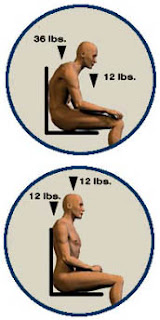
The top figure shows how 90% of us sit at a desk playing or working on the computer. You can see that the hunched over posture creates up to 24lbs of extra strain on the spine. The figure below depicts a correct posture, reducing the load or stress put on the lumbar spine. When there is a consistent increase in stress to the spine we are susceptible to spinal degeneration. The reason is described by Wolf’s Law:
States that bone in a healthy person or animal will adapt to the loads it is placed under. If loading on a particular bone increases, the bone will remodel itself over time to become stronger to resist that sort of loading. The internal architecture of the trabeculae undergoes adaptive changes, followed by secondary changes to the external cortical portion of the bone, perhaps becoming thicker as a result.
Wolf’s Law is telling us that with increased load to the spine, physiological changes are occuring in the spine to compensate for the increase in stress. Overtime, the spine will begin to breakdown due to the physiological changes and lead to an increase in spinal degeneration.
Chiropractic care can be an effective treatment to prevent or slow down the process of spinal degeneration. Chiropractic adjustments are specifically focused to restore proper joint mechanics to the spine. When this occurs the joint has the ability to move and respond appropriately to increases in spinal stress. Of course it does depend on the amount of degeneration that is already present in the spine. Chiropractic doctors can base treatment on the four stages of spinal degeneration, which are:
Degeneration Phase 1
First your spine loses its normal balance. There may be a loss of normal spinal curves. Your nerves may be affected and the vital life energy that flows over them is interfered with. Also your joints, discs, nerves and posture and stressed and age more quickly. Surprisingly, there may be no pain other than occasional minor discomfort. Also present may be a slight lessening of energy and slight height loss. Response to spinal care is generally good.
Degeneration Phase 2
Here there is a much greater degree of decay, disc narrowing and bone spurs (deformations); postural changes are much worse. This condition is very common (by age 40, 80% of males and 76% of females exhibit moderate disc degeneration). Spinal canal narrowing or stenosis may occur. This phase is characterized by more common aches and pains, fatigue and a diminished ability to cope with stress. Height continues to decrease. With chiropractic care significant improvement is possible.
Degeneration Phase 3
Here there are more postural imbalances, increased nerve damage, permanent scar tissue and advanced bone deformation. Physical and/or mental weakness or disability begin. Also found in this phase are permanent loss of height and loss of energy. With care some reversal is possible.
Degeneration Phase 4
This is the most advanced stage of subluxation degeneration. The postural imbalance is severe and motion is limited. There is severe nerve damage, permanent scar tissue is formed and the bones may begin to fuse. In this phase we find pain, various degrees of physical or mental disability, and continued loss of energy and height. By now the condition is considered irreversible, although chiropractic may give some symptomatic relief.
Consult with you Chiropractic doctor if you’re concerned about spinal degeneration.
About the author: Dr. Luke Reineck is a Chiropractor that practices in Milford, OH. Dr. Reineck attended Palmer College of Chiropractic Florida receiving honors of cum laude. His goal for patients is to develop a proactive plan to improve their body’s structure and function to its maximum level. Dr. Reineck can be contacted at his office Living with Motion Chiropractic (513) 831-4433 or email drluke@livingwithmotion.com
Normal “wear and tear” can best be described as LIFE! We all have “wear and tear” on our body. But why don’t we all have spinal degeneration? This is where postural stress comes in. Think of how many hours you sit at work or home? How many falls and accidents have you had? How often do you bend over or lay twisted? These positions and movements create an increased load or stress to the spine. Day in and day out that can affect how the spine moves and functions. Physical, labor-intensive jobs such as construction obviously create more stress than other jobs do. However, jobs that produce repetitive movements such as assembly line jobs or even teachers that are continuously bending over helping kids do their schoolwork impact spinal health. Office jobs may be less labor intensive but sitting in one position all day puts a significant amount of stress on the low back. Lets look at how sitting on a chair (slouching) can affect the amount of stress put on the spine.

The top figure shows how 90% of us sit at a desk playing or working on the computer. You can see that the hunched over posture creates up to 24lbs of extra strain on the spine. The figure below depicts a correct posture, reducing the load or stress put on the lumbar spine. When there is a consistent increase in stress to the spine we are susceptible to spinal degeneration. The reason is described by Wolf’s Law:
States that bone in a healthy person or animal will adapt to the loads it is placed under. If loading on a particular bone increases, the bone will remodel itself over time to become stronger to resist that sort of loading. The internal architecture of the trabeculae undergoes adaptive changes, followed by secondary changes to the external cortical portion of the bone, perhaps becoming thicker as a result.
Wolf’s Law is telling us that with increased load to the spine, physiological changes are occuring in the spine to compensate for the increase in stress. Overtime, the spine will begin to breakdown due to the physiological changes and lead to an increase in spinal degeneration.
Chiropractic care can be an effective treatment to prevent or slow down the process of spinal degeneration. Chiropractic adjustments are specifically focused to restore proper joint mechanics to the spine. When this occurs the joint has the ability to move and respond appropriately to increases in spinal stress. Of course it does depend on the amount of degeneration that is already present in the spine. Chiropractic doctors can base treatment on the four stages of spinal degeneration, which are:
Degeneration Phase 1
First your spine loses its normal balance. There may be a loss of normal spinal curves. Your nerves may be affected and the vital life energy that flows over them is interfered with. Also your joints, discs, nerves and posture and stressed and age more quickly. Surprisingly, there may be no pain other than occasional minor discomfort. Also present may be a slight lessening of energy and slight height loss. Response to spinal care is generally good.
Degeneration Phase 2
Here there is a much greater degree of decay, disc narrowing and bone spurs (deformations); postural changes are much worse. This condition is very common (by age 40, 80% of males and 76% of females exhibit moderate disc degeneration). Spinal canal narrowing or stenosis may occur. This phase is characterized by more common aches and pains, fatigue and a diminished ability to cope with stress. Height continues to decrease. With chiropractic care significant improvement is possible.
Degeneration Phase 3
Here there are more postural imbalances, increased nerve damage, permanent scar tissue and advanced bone deformation. Physical and/or mental weakness or disability begin. Also found in this phase are permanent loss of height and loss of energy. With care some reversal is possible.
Degeneration Phase 4
This is the most advanced stage of subluxation degeneration. The postural imbalance is severe and motion is limited. There is severe nerve damage, permanent scar tissue is formed and the bones may begin to fuse. In this phase we find pain, various degrees of physical or mental disability, and continued loss of energy and height. By now the condition is considered irreversible, although chiropractic may give some symptomatic relief.
Consult with you Chiropractic doctor if you’re concerned about spinal degeneration.
About the author: Dr. Luke Reineck is a Chiropractor that practices in Milford, OH. Dr. Reineck attended Palmer College of Chiropractic Florida receiving honors of cum laude. His goal for patients is to develop a proactive plan to improve their body’s structure and function to its maximum level. Dr. Reineck can be contacted at his office Living with Motion Chiropractic (513) 831-4433 or email drluke@livingwithmotion.com
Friday, February 18, 2011
Create Your Own “Stimulus Package”
Many believe we must have control of our own lives, however, in times of an economic crisis this may seem extremely difficult to do. Loved ones are losing their jobs, we’re trying to pay the bills and stressing over things that previously we would not. One point of good news is that we have the ability to control the way we take care of ourselves.
The small stresses of our daily activities slowly alter the mechanics of our bodies. This occurs day after day eventually leading to aches and pains we associate with everyday life. Consequently, muscles and ligaments change over time, increasing our chances of serious injury down the road. At that point, we will want a “bailout” from chronic pain and all the doctor’s fees.
Whether we talk about a “stimulus package” from the government or one we create for ourselves, it should improve our current situation as well as improve things down the road. In terms of health, we need a solution that will make us feel better now and provide continued health for the future. One solution is chiropractic.
The nervous system controls everything in the body. Every cell, tissue and organ is under the direct influence of the nervous system. Chiropractic adjustments are capable of stimulating the nervous system at a specific spinal level naturally; allowing the body to feel and function better. Chiropractors are well educated in detecting biomechanical faults throughout the body, which in turn could be putting that individual at risk of injury. The chiropractic exam can consist of several tools (x-ray, orthopedic tests, range of motion tests, etc) that allow the Chiropractor to properly evaluate the spine and/or extremities. Benefits from chiropractic adjustments include: decreased pain, restored joint motion, improved flexibility, proper muscle tone, increased circulation, improved immune response, and decreased stress.
Chiropractic care is a conservative option that is versatile in its treatment. Someone with chronic pain or someone with subtle symptoms can both benefit from chiropractic adjustments. When it comes to health and wellness, prevention is easier and cheaper than a cure.
During this economic downturn, the best investment is in your health. Just as we spend money, time and effort on saving and securing our long-term wealth, we should also secure and enjoy our long-term health.
About the author: Dr. Luke Reineck is a Chiropractor that practices in Milford, OH. Dr. Reineck attended Palmer College of Chiropractic Florida receiving honors of cum laude. His goal for patients is to develop a proactive plan to improve their body’s structure and function to its maximum level. Dr. Reineck can be contacted at his office Living with Motion Chiropractic (513) 831-4433 or email drluke@livingwithmotion.com.
The small stresses of our daily activities slowly alter the mechanics of our bodies. This occurs day after day eventually leading to aches and pains we associate with everyday life. Consequently, muscles and ligaments change over time, increasing our chances of serious injury down the road. At that point, we will want a “bailout” from chronic pain and all the doctor’s fees.
Whether we talk about a “stimulus package” from the government or one we create for ourselves, it should improve our current situation as well as improve things down the road. In terms of health, we need a solution that will make us feel better now and provide continued health for the future. One solution is chiropractic.
The nervous system controls everything in the body. Every cell, tissue and organ is under the direct influence of the nervous system. Chiropractic adjustments are capable of stimulating the nervous system at a specific spinal level naturally; allowing the body to feel and function better. Chiropractors are well educated in detecting biomechanical faults throughout the body, which in turn could be putting that individual at risk of injury. The chiropractic exam can consist of several tools (x-ray, orthopedic tests, range of motion tests, etc) that allow the Chiropractor to properly evaluate the spine and/or extremities. Benefits from chiropractic adjustments include: decreased pain, restored joint motion, improved flexibility, proper muscle tone, increased circulation, improved immune response, and decreased stress.
Chiropractic care is a conservative option that is versatile in its treatment. Someone with chronic pain or someone with subtle symptoms can both benefit from chiropractic adjustments. When it comes to health and wellness, prevention is easier and cheaper than a cure.
During this economic downturn, the best investment is in your health. Just as we spend money, time and effort on saving and securing our long-term wealth, we should also secure and enjoy our long-term health.
About the author: Dr. Luke Reineck is a Chiropractor that practices in Milford, OH. Dr. Reineck attended Palmer College of Chiropractic Florida receiving honors of cum laude. His goal for patients is to develop a proactive plan to improve their body’s structure and function to its maximum level. Dr. Reineck can be contacted at his office Living with Motion Chiropractic (513) 831-4433 or email drluke@livingwithmotion.com.
Wednesday, February 16, 2011
What Are The Effects Of Stress On Your Body?
How do you define stress? Is it when you have a million things to get down before the end of your workday? Is it when your children are starting to drive you crazy? Is it when you and your significant other can't seem to get along? All of these situations create stress and are all examples of emotional stressors. Most of us relate "stress" to emotional stress and don't think about or know what else can stress us. But have you thought about the effects of stress when you eat a cheeseburger, drink a soda, or sit all day at work? Just as emotional stressors affect us, these physical and chemical stressors create imbalances in our body driving it further away from homeostasis.
Stress can be defined as a normal physiological response to situations or stimulus, which are perceived as "dangerous" to the body. The human body is complex; it must stay with in a very narrow range of physiological function to maintain homeostasis. The body is exposed everyday to different persons, species, situations and stimuli. If the exposure is hazardous then the body prepares itself to face the situation - the reason being is to maintain internal homeostasis and the bodies normal functioning should not be affected. This response is called the fight or flight response.
The fight or flight response occurs because the body needs more energy when its faced with situations deemed "dangerous". The initial step of this response is taken by the hypothalamus of the brain that in turn eventually stimulates your adrenal glands (located above your kidneys). The adrenal glands secrete two important hormones, adrenaline and cortisol. These two hormones work together to see that the body gets more energy by providing more oxygen and glucose. For these things to occur, the following adjustments are done. First, adrenaline makes blood flow toward your muscles, heart, and brain - and away from the skin and digestive track. Then, your heart beats rapidly and forcefully increasing heart rate and your blood pressure. At the same time your eyes dilate and your blood vessels constrict. Finally, the sugar stored in your liver is converted into glucose (blood sugar) for quick energy during the fight or flight response. Once the trigger is gone, the hormone levels drop and the body returns to normal. However if stress occurs repeatedly, then all the hormone levels are persistently high not allowing the body to come back to normal.
How often do you feel stressed? I think most of us would answer everyday. This means that we consistently have high levels of adrenaline and cortisol running through our blood. Remember, when we are stressed the body is looking for quick energy. To gain more energy, glucagon is being converted into blood sugar. This means you consistently have higher levels of blood sugar than what you should. Think about that. Is it hard for you to lose weight? Has your doctor told you that your headed toward diabetes? Have you improved your diet but still can't control your blood sugar? At my office, Living with Motion Chiropractic, we understand the effects of stress on your body. All day, everyday, your body is adjusting and compensating to maintain homeostasis. The next time you feel back pain from sitting all day (physical stress) or you get angry with your children (emotional stress) or you shovel down a burger with fries (chemical stress), remember how these situations impact your health. Finding a balance in your life physically, emotionally, and chemically will allow your body to respond appropriately to the effects of stress!
Subscribe to:
Posts (Atom)